For most people, baby powder conjures up images of fresh-smelling infants and calming bath-time routines. That signature scent, especially from Johnson & Johnson, is soothing — nostalgic, even. But for 44-year-old Lisa Anderson, baby powder isn’t just a scent. It’s a full-blown craving.
Lisa, a mother of five from the U.K., has been addicted to eating baby powder for the past 15 years. She estimates she’s spent more than $10,000 on the stuff — not to keep her babies dry, but to feed a compulsion that sees her consuming a 200-gram bottle of talcum powder every single day.
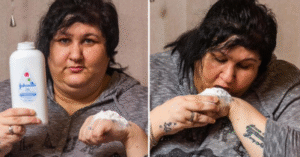
Anderson’s habit is far from casual. She eats the powder off the back of her hand every 30 minutes — even waking up in the middle of the night to satisfy her craving. The longest she’s ever gone without it? Just two days. “That was the worst time of my life,” she says. “I hated it.”
What started as a moment of curiosity in the bathroom spiraled into a years-long addiction. “I’ve always had talcum powder in the house,” she explained. “I’d use it after a bath or shower and on the kids, no problem. Then one day, I remember being in the bathroom, and the smell was just overpowering. There was a bit of dust that had come off the top of the bottle. I had this sudden urge to eat it, and I just couldn’t fight it. I licked it off my hand — and I really enjoyed it. It hit this spot. It satisfied a craving I never knew I had.”
From that moment on, baby powder became more than a household item — it became a need. Lisa kept her secret for the first ten years, hiding it from her now ex-partner, sneaking off to the bathroom to get her fix when no one was watching. “He would ask why I kept disappearing,” she said. “I’d be in there, eating talc.”
Eventually, she came forward and began seeking professional help. Lisa’s condition is believed to be a form of Pica, an eating disorder characterized by a compulsion to consume non-food substances — things like dirt, paint, chalk, or, in her case, talcum powder. Though unusual, Pica isn’t unheard of and can affect individuals of all ages, often linked to underlying mental health conditions or nutritional deficiencies.

Lisa’s story is especially concerning because baby powder — particularly talc-based varieties — can be dangerous when ingested or inhaled. Health officials have raised longstanding concerns about the potential for cancer risks, especially with products containing talc, which can sometimes be contaminated with asbestos. While Johnson & Johnson has maintained that their product is safe, the company has faced thousands of lawsuits and eventually pulled its talc-based baby powder from the U.S. and Canadian markets in 2020, replacing it with a cornstarch-based version.
Despite these dangers, Lisa finds it difficult to resist. “I do get it’s a bit weird — but it just has this nice soapy taste,” she explained. “I can get through a 200g bottle in a day, but with the bigger ones, I go through about one and a half a week.”
She knows it’s harmful. She knows she shouldn’t be doing it. But that hasn’t stopped the cravings — or the ritual. “I can’t go half an hour without it,” she admits. “It’s become part of my routine. I don’t think I could go a day without it now.”
Though she’s working with professionals to manage the disorder, her story highlights the complexity of addiction — and how even something as seemingly benign as baby powder can turn dangerous when cravings go unchecked.