
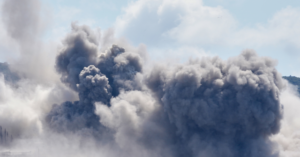
A detonation under the Ali al‑Taher ridge in southern Lebanon was powerful enough to register as a magnitude 4.1 seismic event, according to the U.S. Geological Survey as cited in the source material. Onlookers filmed the blast, and a resident in nearby Nabatieh told the BBC it felt like an earthquake.
What Israel says it destroyed
The Israel Defense Forces (IDF) said it demolished a large underground complex beneath the ridge, located roughly ten miles from Israel’s border, per the source text. Israeli officials described the site as more than a mile wide and stocked with “dozens of Iranian-made rockets, missiles, and UAVs, as well as machine guns, dozens of anti-tank missiles, and hundreds of mines and explosive devices.” They also said the tunnels housed a command center for Hezbollah’s Badr unit.

The IDF released footage it said showed soldiers and drones inside the tunnels. In a joint statement attributed to Israeli Prime Minister Benjamin Netanyahu and Defense Minister Israel Katz, the complex was called “strategic terror infrastructure built over two decades, with Iranian funding and planning,” and was described as intended “to serve as the staging base for the conquest of the Galilee,” with observation and fire coverage over Metula and Kiryat Shmona. The statement added that destroying the site “completes the achievement of operational control over the Ali Taher ridge — above and below ground.”
How the operation unfolded, according to the IDF
Brig. Gen. Yiftach Norkin, commander of the IDF’s 36th Division, called it “one of the most complex operations we have carried out,” saying forces operated above and below ground “while maintaining strict protection of our forces.” He said the tunnels were destroyed with “1,100 tons of explosives,” which he asserted severely degraded Hezbollah’s command-and-control in the area.
Claims on the fight inside—and on Iran’s role
Unnamed IDF officials who spoke to the Jerusalem Post characterized the loss as a “devastating blow both psychologically and physically” for Hezbollah and described deception tactics preceding the assault. According to those officials, about 50 Hezbollah fighters were trapped in the underground base, some fled, and others refused Israeli offers to surrender; Hezbollah allegedly tried and failed to resupply them. The same Jerusalem Post account claimed Hezbollah made public and private appeals to Iran for help and that “Tehran declined to get involved.” The IDF also stated that, contrary to early rumors, no Iranian personnel were captured or killed inside the complex. These accounts are attributed to Israeli officials via the Jerusalem Post and have not been independently verified here.
The blast that felt like an earthquake
The U.S. Geological Survey detected tremors equivalent to a magnitude 4.1 earthquake, with shaking reported miles away, per the source material. A resident of Nabatieh told the BBC: “The sky lit up and about 15 seconds later we heard the terrifying sound. The house shook all together as if it was literally an earthquake,” adding that “people were screaming and children were crying,” and that some neighbors attempted to evacuate toward Beirut.
Diplomatic backdrop reported by France24
France24 reported that during June talks with Iran, the United States proposed allowing the Lebanese Army to assume control of the Ali al‑Taher ridge while Hezbollah evacuated, but Hezbollah refused.
Analysts’ view on intent and impact
Fox News quoted analysts who argued the Ali al‑Taher base was intended as a staging ground for an “October 7‑style” incursion into northern Israel, and that Israeli operations had eliminated up to 90 percent of Hezbollah’s rocket and missile stockpile. Those assessments are attributed to analysts cited by Fox News.