It’s a strange day in America when a guy can’t profess his love for bean curd without someone at the DMV clutching their pearls. But alas, here we are.
Peter Starostecki, a mild-mannered vegan from Maine who champions tofu, animal rights, and public education, has found himself on the wrong end of the state’s new war on “offensive” license plates. His crime? Wanting to tell the world he LUVTOFU — or so he thought.
Apparently, not everyone in Augusta can read basic English.
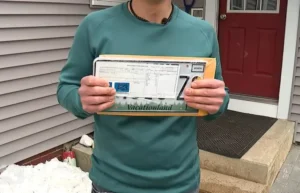
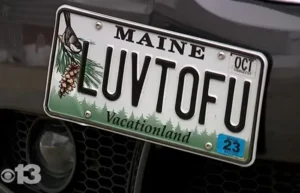
The vanity plate in question — LUVTOFU — seemed harmless enough. Unless, of course, you’re part of the Maine Bureau of Motor Vehicles, where someone squinted at it, tilted their head, and decided it read “love to f— you.” You know, because clearly, tofu enthusiasts are constantly driving around shouting obscenities at people through cryptic wordplay.
Starostecki, who has devoted much of his life to advocating for special needs children, ran for local office, and—gasp—eats tofu instead of burgers, now finds himself in a bizarre cultural crossfire over six letters and a vowel.
Let’s be honest. If your mind immediately jumped from “LUVTOFU” to an X-rated proposition, maybe the problem isn’t the license plate.
The tofu plate wasn’t a rogue one-off, either. Maine officials have been on a tear lately, banning 274 previously approved vanity plates in an effort to scrub the highways of anything that might cause someone, somewhere, to be slightly less than thrilled. This is part of the state’s initiative to vet all new personalized plates going forward, lest someone mistake “GR8LIFE” for a veiled threat.
After the tofu crackdown, Starostecki appealed the decision — because why wouldn’t he? But the state rejected all his appeals. They did offer him a fallback: a vanity plate that spelled “VEGAN” with a “3” instead of the “E,” which is basically the alphabet equivalent of putting kale on pizza and calling it “edgy.”
Understandably, he declined and settled for a plain old plate like the rest of us boring carnivores.
Starostecki isn’t alone. He joins a growing list of Mainers who’ve run afoul of the license plate thought police. Heather Libby of Jonesport, for example, had matching vanity plates with her best friend that referenced, in her words, “a female dog.” You can probably do the math there. The state said “nope,” and now she’s back to honoring her dog Zeus — which, by the way, she jokingly fears could also offend someone.
“People are so sensitive nowadays,” Libby said, channeling the thoughts of roughly 95% of the country. “I just think it’s foolish.”
And she’s not wrong.
The state’s rationale comes straight from Secretary of State Shenna Bellows, who insists that free speech ends where vanity plates begin. You can say whatever you want on a bumper sticker, she explained, but when it comes to state-issued metal rectangles, it’s government property — and thus, your message must pass the official vibe check.
“We have a public interest in keeping phrases and words that are profane or may incite violence off the roadways,” Bellows said, presumably while seated beneath a framed copy of the First Amendment with a big red asterisk next to it.
So let’s review. You can slap a sticker on your bumper that says, “Meat is murder” or “My kid beat up your honor student,” and you’re golden. But if you want the state to print “LUVTOFU” on a license plate, it’s suddenly an act of social insurrection.
Got it.
The bigger problem here isn’t that someone at the DMV misread Starostecki’s license plate. It’s that this kind of absurd micromanagement is now baked into the system. Government workers are combing through vanity plate applications like CIA codebreakers, looking for any possible way to get offended on behalf of imaginary victims.
And all for what? To protect unsuspecting motorists from the unfiltered horror of a tofu pun?
Meanwhile, actual obscenities and gestures still roam free in traffic every day. Let’s not pretend that censoring “LUVTOFU” is going to make our roads any more polite.
Of course, the state insists they’re just trying to maintain “decency.” But one person’s decency is another person’s censorship. And while it might be easier to just slap “NORMAL1” on your plate and call it a day, that’s not the point.
The point is that even tofu deserves a little love — and maybe, just maybe, the government doesn’t need to be in the business of interpreting vanity plate double entendres.
In the end, Peter Starostecki is back to driving a plain old car, with a plain old license plate, in a world that now finds tofu controversial. His advocacy hasn’t stopped, though. He’s still promoting plant-based diets and looking out for kids with special needs. Just don’t expect him to advertise it on the back of his car anytime soon.
Because if LUVTOFU is too offensive for Maine’s highways, then we may be closer to “Idiocracy” than we thought.