Scars tell stories. Sometimes they’re reminders of childhood stumbles, surgeries, or scrapes with danger. Sometimes they’re private. Other times, they’re front and center—etched into a face, an arm, or a memory. And no two are exactly alike. That’s what makes them so fascinating. Each one has a backstory, a moment that left its mark both literally and figuratively.
Personally, I carry a scar from a dog bite I got as a kid. It’s right there on my face, and while I could look at it as a flaw, I choose to think of it as a “battle scar.” A reminder that I survived something intense—something that could have changed my life forever. I was lucky. And that’s the common thread in the stories we’re about to share: survival.
But these aren’t your average scars. These are rare. Unnerving. Stunning. They look like nature’s tattoos, but they come at an unimaginable cost. These are the scars left behind by lightning strikes.
Yes, you read that right—lightning. One of the most violent and unpredictable forces of nature can leave behind what are known as Lichtenberg figures or “lightning flowers.” And they are both terrifying and breathtaking. Bored Panda curated a gallery of these remarkable images, and they’ve left the internet amazed.

These intricate, fern-like patterns appear on the skin after a lightning strike, forming what scientists call “fern-like erythema.” They’re thought to be the result of blood vessels—specifically capillaries—bursting just under the skin as the electrical charge blasts its way through the body. The result is a natural fractal. A perfect pattern born from chaos and energy.
Think about that for a second. In one moment, your body becomes a canvas for a force that travels at over 270,000 miles per hour. That’s nearly the speed of light. The temperature of a lightning bolt can reach 30,000 degrees Celsius, five times hotter than the surface of the sun. The voltage? Try 100 million volts.
And yet somehow, people survive.
These scars, while stunning, are usually temporary. Some fade within days or weeks. Others stick around a bit longer. But all of them serve as a vivid reminder: lightning is no joke.
You might think, “Well, that’ll never happen to me.” And statistically, you’re probably right. The odds of being struck by lightning are about one in ten million. Still, that’s considerably better odds than hitting the Powerball, which sits around one in 292 million. So it does happen. And when it does, it leaves behind more than just shock.
Lightning strikes can cause serious, long-term damage to internal organs. Victims have reported neurological issues, memory loss, and chronic pain. In some cases, it can be fatal. That’s why, when a thunderstorm rolls in, the smartest thing to do is get indoors. Quickly. Avoid metal objects. Stay away from open fields. And absolutely don’t stand under a tree.
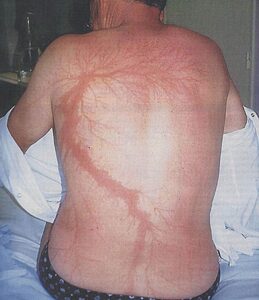
The Royal Meteorological Society has studied these lightning scars in depth. According to their findings, the branching pattern—called a fractal—is formed when electrons are forced into the skin and radiate outward in tiny forks. It’s the kind of thing that looks like a sci-fi special effect, but it’s entirely real.
Comments online range from awe to empathy:
“It probably hurt like hell, but it’s amazing.”
“Holy smoke, these people look like they are very lucky to be alive. I wonder if they bought a lottery ticket after surviving that.”
“They’re really quite beautiful.”
“These fern marks are not permanent. They go away after a few months. My cousin was struck by lightning, and this happened to her. A miracle they survived.”
And that’s exactly it. These are survivors’ marks. They’re not something anyone would wish for—but if they’re there, they tell the world that someone made it through something extraordinary.
So next time you hear thunder rumbling in the distance, take a moment. Respect the storm. And if you ever meet someone with one of these rare marks, know that behind that fern-like scar is a story of sheer survival and the incredible power of nature.